The Dynamics of Integrity: An Interview with a Priest
“Those who preach their own integrity, especially to themselves, are usually the first suspects.” — Father Cyril Hovorun
Dmytro Gadomsky: How do you understand the concept of integrity outside the context of the fight against corruption?
Father Cyril Hovorun: As a moral category with a wide range of interpretations. Moral categories are very important for Ukraine, especially now and especially in relations with Western partners. That is why I became interested in this topic.
D: Could you interpret this moral category?
Fr. C: It is a category that implies a distinction between good and evil, as well as a person’s voluntary effort to choose good.
Ivan Mishchenko: Both good and evil are rather relative categories. What should we rely on to distinguish between them in everyday life?
Fr. C: That is exactly the point: they should not be relative. Their relativisation destroys ethics. Ethics is based on these categories and presupposes their universality. Of course, applying them in life is more difficult than distinguishing between them in theory, but implementing this distinction is also an important ethical task. It involves interpretations, and those interpretations may be relative.
In fact, the interpretation of integrity is about applying the idea of integrity, which has a certain universality.
I: Today, we most often use the concept of integrity in the context of corruption. Is there a similar or close concept in Christianity?
Fr. C: We can speak about Christian ethics, and about integrity as part of it. But Christianity cannot be reduced to ethics. Christianity reduced to ethics is pietism.
I: Do you use this word at all as a priest? Is there a synonym?
Fr. C: I think decency is the closest synonym. The roots of the ethical category of integrity are still in antiquity. This includes Aristotle’s Nicomachean Ethics and Eudemian Ethics, and even more so Stoicism, especially in its Latin version.
I: What would be a synonym for lack of integrity? Sin?
Fr. C: Sin is a much broader category. Lack of integrity is part of it, but does not exhaust it. In particular, sin may be individual, or it may be communal, meaning that it relates to social and political life.
Lack of integrity belongs precisely to that kind of life. The Greeks would have placed it within the life of the polis. By the way, laws as codifications of ethics also originally concerned the life of the polis.
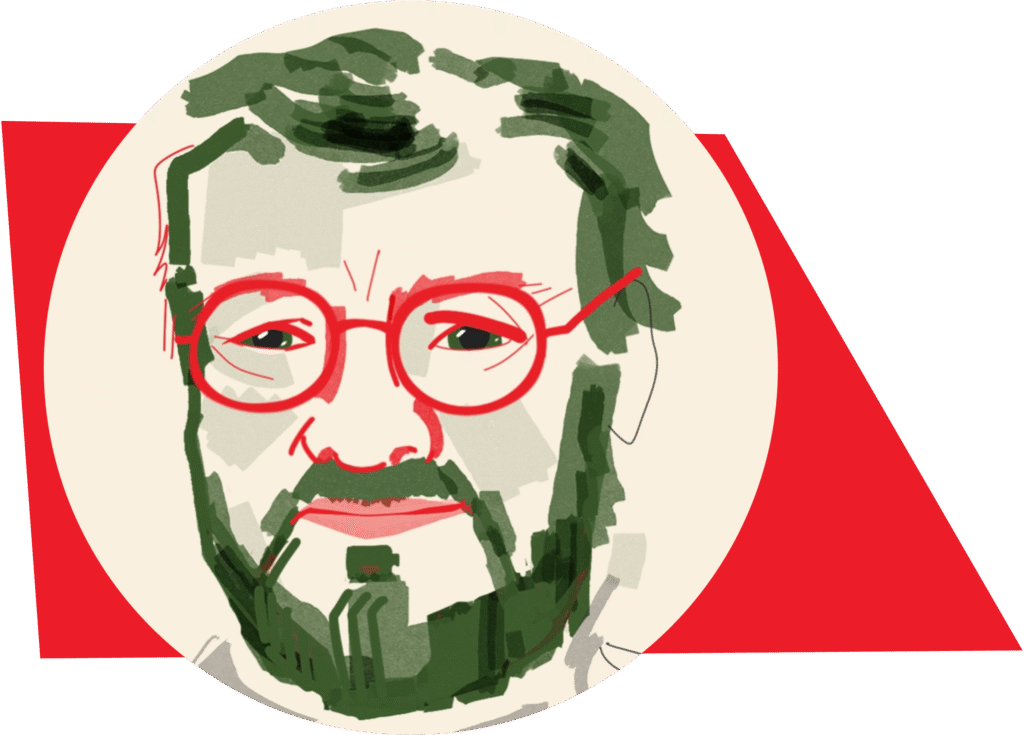
Father Cyril Hovorun is an Orthodox priest and scholar. He holds a Doctor of Philosophy degree in Theology, is a professor at Loyola Marymount University in Los Angeles, director of the Huffington Ecumenical Institute in the United States, and a professor at the Stockholm School of Theology. He is the author of numerous academic works and several monographs published in English and Ukrainian. He has taught at Yale University, Columbia University, and the University of Alberta in Canada.
Dr Hovorun previously headed the Department for External Church Relations of the Ukrainian Orthodox Church. As First Deputy Chair of the Education Committee of the Moscow Patriarchate, he was responsible for modernising the system of theological education in the Russian Orthodox Church.
In January 2019, he supported the establishment of the Orthodox Church of Ukraine, although he did not formally join it. At the same time, in his English-language articles, he repeatedly promoted the idea of autocephaly for the Ukrainian Orthodox Church.
I: Could we draw an analogy and say that we are all lacking in integrity from the moment of birth, and only strive toward integrity?
Fr. C: That is more a category of Western Christianity, but Eastern Christianity also recognises that a person has an inclination toward lack of integrity. This inclination must be overcome through an act of will. In Christianity, the presence of grace is also important, meaning God’s help.
In Orthodoxy in particular, it is customary to speak of synergy, a cooperation between the human person and God, between human will and divine grace. Lack of integrity can be overcome in oneself precisely through this synergy.
I: So there is a certain dynamic, an internal dichotomy of “integrity and lack of integrity”, “good and evil”, or, more broadly, every person has an experience of sin. How would you describe this dynamic?
Fr. C: Yes, every person has an inclination toward sin, and therefore toward lack of integrity, and also has experience of this lack of integrity. In addition, this experience is accompanied by an understanding that this is lack of integrity and that it is bad. So a person tries to push away from this experience and this understanding in order to reach integrity.
I: Forgive me for a very provocative question, Father Cyril, but Russians do not seem to strive very much toward integrity, from what I have observed.
Fr. C: They understand it in their own way, and they strive toward that understanding. Russians have ended up with a completely distorted ethical scale. Incidentally, it was the church that distorted it. It did so in the name of restoring the ethical scale, which, in their view, had been broken by Western liberalism.
I: So a person can be mistaken not only in their actions, but also in their assessment of what they are actually striving for?
Fr. C: Absolutely. All the evil in the world does not come from people striving for evil, but from people falsely interpreting good. For the Nazis, for example, the extermination of Jews was good for humanity. For Russians, such “good” is the destruction of Ukrainian identity.
I: What gives you, or in the broader sense, us, the good people, the right to interpret good and evil? Why are our claims correct, and theirs mistaken? What is the absolute criterion?
Fr. C: For me, that criterion is the Gospel. It gives clear criteria for distinguishing between good and evil.
I: But Russians have the same criterion!
Fr. C: Yes, but we believe that they distort the Gospel and do not correspond to it. Besides, there is also conscience, which we consider a universal and living criterion of good and evil. Conscience cannot be relative. This is what allows us to interpret Russian aggression in universal categories, without allowing its assessment to be relativised.
I: In your view, does a person have this absolute internal criterion? Tertullian said that the soul is by nature Christian. In other words, even when a person distorts the Gospel, as in our example, do they still understand somewhere deep inside that this is a mistake?
Fr. C: Yes, that is precisely conscience. And Christians believe that it fully correlates with the Gospel. So I think that even Patriarch Kirill, deep down, understands that what he says and does is evil.
There is such an expression: a seared conscience. This is when a person loses the universal criteria for distinguishing between good and evil.
Those who preach their own integrity, especially to themselves, are usually the first suspects.
Father Cyril Hovorun
I: If we return to the dynamic of integrity and lack of integrity, can they coexist? Can I act without integrity, say steal, in order to help my family?
Fr. C: There are many moral dilemmas where a person chooses the lesser evil. But they must continue to understand that even the lesser evil is still evil. This also applies to killing in war.
A person should rely on conscience. If they are a believer, also on the moral norms of their religion. In addition, on laws. They are not perfect, but still a codification of morality. That is why it is important to follow both the letter and the spirit of the law.
I: Fine, let us return to earthly matters. In Ukraine’s judiciary, there are quite a few selection competitions, and a mandatory stage in each of them is the assessment of integrity. In such an assessment, would you proceed from the presumption of integrity or lack of integrity of the candidates?
Fr. C: I would proceed from the fact that every person has experience of lacking integrity, and that it is important to assess their ability to overcome this lack of integrity within themselves. But how to measure this outside confession, I do not know. In other words, I would assess not so much the static state of integrity as the dynamic of moving toward it. Put differently, resilience against lack of integrity, immunity. Because a person who has no immunity may later face temptations in a high office that are hard to overcome, even though before that they seemed to have integrity.
I: So, to admit to acts lacking integrity? In practice, I cannot imagine such a scenario.
Fr. C: I would not trust a person who does not acknowledge their own acts lacking integrity. Because everyone has them.
I: But people usually just want to make a good impression. No one is in a hurry to open their soul before strangers in official procedures. Rather, everyone tries to prove that they have never done anything lacking integrity, and if they have, then it was only some minor thing.
Fr. C: Those are exactly the candidates I would reject. Of course, no one will incriminate themselves, but the recognition of one’s own mistakes is an important criterion of maturity.
I: Then with your participation no one would pass. People tend toward self-justification and compromise, because society is built on such compromises.
Fr. C: Perhaps. Or perhaps people would assess their own possibilities differently. In any case, those who try to convince others, and even more so themselves, of their own integrity are the most likely candidates for lacking it.
I: Fear the saints?
Fr. C: Yes. Ukrainian society has become pietistic and maximalist, which is understandable in wartime. But this produces even greater cynicism and hypocrisy among those in power, from whom purity is expected. I think Ukraine now somewhat lacks the right to make mistakes. Of course, the right to make mistakes can be abused, like anything else. But without such a right, the level of hypocrisy will go off the scale.
D: In one of your academic works, you explore the concepts of uncertainty and accidentalism. If I understood you correctly, many conflicts are fed not by essential differences, but by accidental ones. There can be no discussion about essential concepts, while flexibility is possible in secondary features. It is precisely the confusion between these concepts that produces hypocrisy and schisms. In defining the “integrity” of a candidate for judicial office, what is essential and what is secondary?
Fr. C: Essentially, the candidate must have a clear understanding of what has integrity and what does not. And the candidate must demonstrate the accidents of their own integrity, preferably in the dynamics of development. In other words, the candidate must show immunity as an accident.
D: The second word whose existence I learned from your works is ecumenism, a movement from cooperation toward reconciliation. You speak about ecumenism between confessions, and I want to ask about ecumenism in the matter of corruption. For more than twenty years of independence, corruption was deeply rooted in Ukraine’s economy and in some places was not even perceived as something bad. Based on my naive observations, after the Revolution of Dignity corruption has been defining our economy less and less. But judges who worked then continue to work now, side by side with judges for whom corruption is taboo. Is reconciliation “between confessions” possible here?
Fr. C: These are still different kinds of reconciliation. Inter-confessional ecumenism proceeds from the fact that people found themselves in different confessions not because of their own moral choice. That is different from the category of judges they fall into. Because being a judge without integrity is a person’s moral choice.
Reconciliation between such morally defined categories can be discussed within what is called transitional justice. Or restorative justice.
D: Yes, I understand that judges with integrity and judges without integrity are not an analogue to different confessions. But judges for whom corruption was not something lacking integrity before the Revolution of Dignity became that way because of the circumstances in which we and they found ourselves: the collapse of the USSR, poverty, the absence of moral authorities.
Fr. C: But it was still their moral choice, and their conscience was the same as everyone else’s. Even if it was an accepted norm. Conscience testifies even against social or corporate norms.
I would not trust anyone who refuses to admit their own failures of integrity. We all have them.
Father Cyril Hovorun
I: When Jesus was tempted by the devil in the desert, did he become lacking in integrity from the point of view of an outside observer? For example, if a judicial candidate once had dealings with a person lacking integrity, say had coffee with them in a restaurant, does that mean the candidate also becomes forever lacking in integrity?
Fr. C: No, communication with someone lacking integrity is not itself an act lacking integrity. It becomes such an act when a person begins to relate themselves to that lack of integrity, or to benefit from it.
I: Many Christian saints, before becoming saints, were villains, murderers, thieves, and so on. Does this mean that in ordinary life a candidate lacking integrity can change toward integrity?
Fr. C: That is exactly what we have been discussing. In real life, only this kind of dynamic is possible. People are not born saints.
I: Who, for you personally, is an example of integrity?
Fr. C: Christ. He is absolutely full of integrity. Everyone else is so only to varying degrees.
I: And among living people in our own life?
Fr. C: I do not know absolute examples. But what I value most in people is not who they are in moral terms, but who they have become through the synergy I mentioned earlier.
I: Let me add a bit of context. The commissions we have mentioned assess the integrity of candidates. But who assesses the integrity of the commission members themselves? In practice, other commissions do, but very quickly we end up in a recursion trap.
Fr. C: Exactly. Christ criticised the Pharisees, who judged others but did not meet their own standards of judgment.
I: But even the slightest doubt about the integrity of commission members undermines trust in the whole process.
Fr. C: Yes, this is something of a closed circle. That is why I think we should move away from moralising pietism and purism, and allow for the right to make mistakes. But then society must reach a consensus on which mistakes are acceptable.
I: In your view, is it appropriate to assess the integrity of a future judge as a separate moral and psychological category? If not, what exactly should be assessed?
Fr. C: It is appropriate. And, as I have already said, what should be assessed is not the absence of the virus of lacking integrity in the organism, but the presence of antibodies against it.
I: Sometimes a candidate is recognised as having integrity during a competition, but later commits a crime, including a corruption offence. Society then begins to criticise the competition itself, as if it had some flaws that allowed a candidate lacking integrity to mislead everyone. Is this correct?
Fr. C: It may be, or it may not be. Because society suspects that someone turned a blind eye to lack of integrity. Although this may not be the case. But this will happen more often if attention is paid not to antibodies, but simply to the absence of the virus.
I: Last question: how would you advise overcoming the virus of lacking integrity and strengthening immunity?
Fr. C: Zero tolerance for corruption is part of the process. But the right to make mistakes, together with a demonstration of how the mistake was corrected and why it will not be repeated, should also be part of it.
*This publication was prepared by Dead Lawyers Society within the framework of a grant provided by the EU Project “Pravo-Justice”. Its content is the sole responsibility of Dead Lawyers Society and does not necessarily reflect the position of the European Union.