General Coward and the Green Shit
Late summer of 2024. It was supposed to be a routine run to the position. Nothing unusual, nothing new. The main thing was to slip past the zeroed-in points, and that would be that. Prokop was supposed to drive us. He had joined us relatively recently and was our driver. He didn’t have a ton of experience driving in combat conditions yet, but he had enough skill and character.
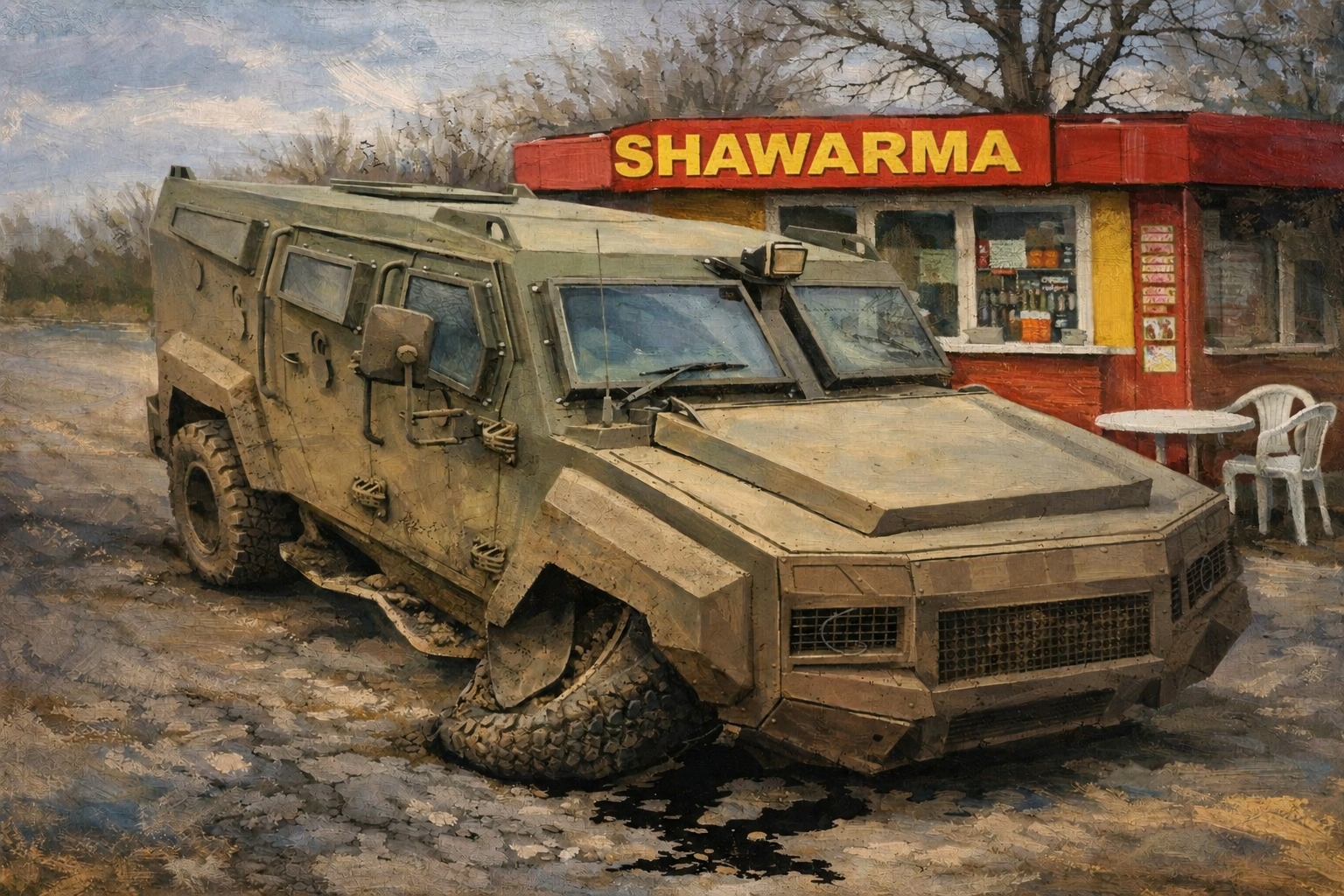
So we climbed into the Canadian-made armored vehicle Roshel. Before departure the platoon commander looked at us all with a sad face and said, “God be with you, lads.” He always looked at us like that before leaving and always said the line. For him it was a kind of ritual. For us it became a ritual too.
On the way we joked and took in the scenery—as much as you can at night. At one point we saw a bright flash near Bakhmut. It was a very beautiful sight, if you didn’t consider that it was the “exit” of something very heavy and dangerous. I wouldn’t want that fired at me.
Approaching the position, we saw a green light on the hood of our vehicle. That was not a good sign. By then we had already heard about the use of the Zala UAV with that lamp. It lights targets for the Russian long-range artillery firing the guided Krasnopol round. That round is laser-guided and hits very precisely—designed to strike armored vehicles. And we were riding inside one.
Prokop didn’t see the green beam because he was looking at the road through a night vision device (NVD), and the beam didn’t show in it. Bandera noticed the light well and shouted, “Floor it! They’re about to start blasting!”
Bandera styled himself “General Scyklo.” After being wounded in the infantry he didn’t like to poke his head out of the dugout unnecessarily. Still, when needed he did: he might grumble, but he dutifully did the job. As a driver he was first-class—he wouldn’t hand the controls to just anyone. He was called “Bandera” because he was born in the Belgorod region. In any case, his instincts were to be trusted.
Prokop trusted him. As soon as the vehicle began to pick up speed, we again saw an “exit” from the Bakhmut area, and a few seconds later a “hit” landed about thirty meters behind our Roshel. At that point the armored vehicle’s crew pushed it to the max in the conditions of complete off-road. Since Prokop still hadn’t seen the green beam, Bandera started calling out corrections to him.
I looked at the amount of ammo in the cabin and thought: if they hit us, I don’t have to worry about whether they’ll cremate me—there’d be little left of me anyway. And if they miss, all the more reason not to worry. Then I looked at Keks. His face wore the ultimate “I-don’t-give-a-fuck” look. Seems he was thinking the same. Many mistakenly thought Keks was indifferent. I knew that wasn’t entirely true. He did care about a number of things connected to military stupidity. Keks and I go back to training days (see the link), and that’s long enough to understand each other without words. On the position I could always rely on his prudence and dependability. I repaid him by trying, on downtime, to pull him into civilization for a break so he wouldn’t stew in his own thoughts.
At that moment a third round landed near us. It was the first time I saw such precise fire on a moving target. Then two more landed nearby. That’s how we made it to Kostiantynivka. Then I realized I wasn’t afraid to ride with Prokop: he didn’t panic and he got us all out alive and uninjured.
While unloading, Lys and I joked that the aliens had wanted to abduct us because we were too handsome. We found it funny at the time. Throughout the whole drive I didn’t see much fear on Lys’s face. If you’ve been fighting for about seven years, it’s hard to be surprised by much. In that time Lys had been a lot of things: an infantryman, a grenadier, a mortar gunner, a UAV operator. On summer evenings we’d sometimes sit by the house and play the game “is that a falling star or a recon drone?”
Because of these adventures we had to reschedule the run for dawn. When we drove in in the morning it was absolutely quiet. So we decided to change the rotation times to dawn or evening twilight.
A month passed. Rotations went well. The problem was that we’d been on these positions too long. The planting area was regularly pounded by a 120-mm mortar, FPVs would come in, and as the cherry on top—those bastards regularly conducted remote mining with “petals.” I wouldn’t want to step on such a mine; I still need my feet.
The rotation was going successfully. We were vigorously destroying the enemy. I successfully acclimated a new fighter on the position with the call sign Frank. At least, that’s what makes me feel good. Frank handled night flights well. Everything pointed toward the rotation. We told the next group to leave 15 minutes earlier, because it was the end of September and it was getting dark sooner. The main thing was not to drive in after dusk. The next shift didn’t leave earlier.
We waited for transport. At that moment Semen took a photo of me. It’s not really his name, but that’s what we called him. A very good man: helpful and supportive. But I wouldn’t betray him—better not bother a man who’s been boxing as long as he has. Bandera started grumbling that taking a photo before departure was a bad omen. Keks joked that now we could make the photo black-and-white and add a black ribbon.
We heard our Roshel approaching. An FPV was buzzing as well. Keks and I immediately brought our rifles to combat readiness and began “icing” the sky. The FPV worked at some distance—it seemed it hadn’t come for our souls. As the vehicle drew near, we heard impacts. We didn’t give it much thought, because we could fire at zeroed-in points.
Then there it was—our Roshel. We ran out to meet it to help the guys unload faster and jump on ourselves. Suspiciously, the vehicle didn’t slow down. Passing by us, the driver shouted, “Green shit!” We understood he meant the Zala with that cursed beam and scattered in different directions.
Lys, Bandera and Semen ran to the dugout. Keks, Frank and I went to another entrance. Of course, at that moment we forgot it was blocked with branches. Realizing we couldn’t get inside, Keks and I dropped to the ground; Frank copied us. We did it in time: at that very moment a Krasnopol round landed fifteen meters away—right where the vehicle was supposed to stop. I watched the explosion up close because I fell onto my back. I regretted never buying a GoPro.

So we lay there, watching the Roshel drive off. Reaching the edge of the planting area, the vehicle ran over the scattered petals.
— Did they just hit petals? — Keks asked.
— Yeah, — I replied.
We understood we wouldn’t be relieved today.
The next day an M113 came for us. They hadn’t had time to fix the Roshel’s wheels. We expected the little box to be greeted the same way, but no—the rotation passed quietly. Though on the way the gunner’s seat pinched my fingers. I grabbed on for the wrong reason. The guys said that because of my screams and the red headlamp lights the scene looked like a horror film. I was shouting more because the gunner couldn’t hear me over the rumble of the vehicle than from pain.
After a while we smelled shawarma. It was weird: how can a combat zone smell like shawarma?
— Are we in Kostiantynivka? — Lys asked the gunner.
— Yep, — came the answer.
— Then for fuck’s sake, stop! We want to eat! — Lys shouted.
We really wanted to eat. Armor wasn’t supposed to enter the town—the plan was to drop us off earlier. It seemed the driver understood that and began to turn around.
— Hey, where are you going?! — Lys shouted.
— Your guys are waiting at the armor group!
— Maybe we’ll wait for our guys here with shawarma? — Lys held his ground.
The driver didn’t listen and kept course back. Still, Lys and I later did get to that shawarma place. On the way Lys demonstrated his drifting skills.
In the summer of 2025 our Roshel was struck by an FPV. Then a few more hit. The vehicle wasn’t destroyed; they even managed to tow it for repairs. Fortunately, no one was hurt—the armor held. Our battle vehicle is still under repair now, and how long that will take is unknown. It’s sad, because that Roshel became a symbol for us.
Збір на транспорт для літунів Айдару
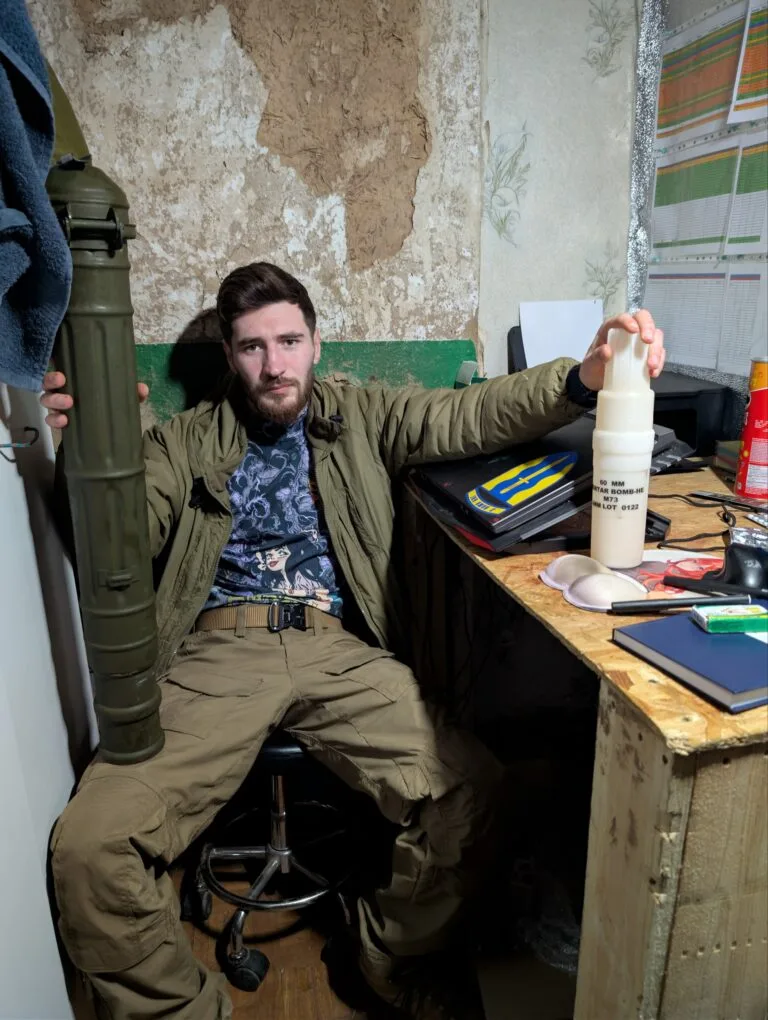
Ну привіт. Я Чернець із Айдару і ви щойно прочитали історію з мого щоденника. Нам би якось замінити той тазік, про який ви щойно прочитали. Буду вдячний, якщо допоможете закрити збір. Alex Chernetsky